
- Customer Stories
- PathGroup
The Last Frontier: How PathGroup Brought Digital Pathology to Hematology
PathGroup’s surgical pathologists were already fully digital. But for hematopathology - where 100x resolution across the smear is non-negotiable - the microscope remained. Until now.

Remote work capacity
Standardized, AI-powered WBC differential
Microscope reversion
About PathGroup
PathGroup is one of the largest privately held, physician-owned pathology groups in the United States, providing anatomic, clinical, and molecular pathology services through more than 250 hospitals and thousands of physician groups across 25 states. With more than 240 subspecialty expert pathologists, the organization covers every subspecialty in the field of pathology at scale.
PathGroup has made digital pathology a strategic priority across its enterprise. The organization has digitized millions of pathology slides, using multiple FDA-approved platforms and proprietary AI tools to deliver faster, more accurate diagnostics. Surgical pathology is already fully digital across the network.
Dr. Derek C. Welch, President and Chief Medical Officer at PathGroup, has described the organization’s digital strategy as patient-care driven: “Until you have a digital image, you cannot do the things that enhance patient care - from quality and having a correct diagnosis to artificial intelligence tools that query for clinically actionable mutations.”
In 2023, PathGroup opened a new approximately 130,000-square-foot facility in Coppell, Texas, outside Dallas. The site houses a full-service clinical laboratory, flow cytometry lab, and the hematopathology service led by Dr. Robin Dobson. By opening the Texas lab, PathGroup decreased sample transit time for cases that previously traveled to Nashville, Tennessee - improving sample integrity and time to results.
The Coppell lab operates as a reference laboratory, receiving slides from partner labs across the network for scanning, review, and sign-off by PathGroup’s hematopathology team.
- InstitutionPathGroup
- LocationCoppell, Texas
- TypePhysician-owned reference pathology group
- Network250+ hospitals across 25 states
- Pathologists240+ subspecialty experts; 8 hematopathologists
The challenge
PathGroup had made significant progress in digitizing its pathology services. Surgical pathologists across the enterprise were already working on fully digital workflows. But hematopathology remained analog.
The core barrier was technical. Peripheral blood smear review demands 100x resolution to evaluate chromatin patterns, granularity, and subtle morphologic features. At the same time, the pathologist needs to navigate all clinically relevant areas of the smear - assessing red blood cell morphology across the monolayer, checking the feathered edge for platelet clumps, and seeing white blood cells in context. No available digital system delivered both.
“Hematopathology and cytopathology have been the final frontiers for digitization because of the barriers to getting the 100x field for peripheral blood smears.” - Dr. Robin Dobson, MD, FCAP, Director of Hematopathology, PathGroup
At the same time, workforce pressures were intensifying across the industry. The pathology community faces both declining reimbursements - demanding greater productivity from existing teams - and a national workforce shortage, with approximately 25,000 annual job openings for medical laboratory scientists against only 5,000 graduates. For PathGroup, with its multi-state footprint, the ability to distribute work efficiently across sites and enable remote coverage was becoming a strategic imperative, not a nice-to-have.
Other digital morphology systems on the market offered cell snapshots, but for hematopathologists who perform a full pathologic review of every peripheral smear accompanying a bone marrow, seeing only pre-selected cells without the surrounding morphologic context was not enough. They needed a solution that could deliver the full diagnostic view digitally.


For my practice, we need a full pathologic review of each smear, not just a review of the automated cell counts. You really need to look around the slide at red blood cell morphology, platelets, and white blood cells within the smear itself.
Dr. Robin Dobson, MD, FCAPDirector of Hematopathology, PathGroup
The solution
PathGroup deployed the Scopio X100HT scanner and Full-Field Peripheral Blood Smear Application* at its Coppell laboratory - bringing AI-powered digital morphology to the hematopathology team for the first time.
The transition replaced the manual microscope-based smear review with a fully digital workflow. Two technologists in the histology lab scan incoming slides on the X100HT, which processes up to 40 slides per hour with its 30-slide loader. Scanned cases are then assigned to the relevant hematopathologists, who review and sign off digitally - whether on-site or remotely through the secure hospital network.
Full-Field review, not snapshots
The difference Dr. Dobson’s team experienced was immediate. Unlike systems that present a gallery of pre-selected cell images, the Scopio platform provides a continuous, navigable digital view of all clinically relevant areas of the smear at 100x resolution. Pathologists can pan across the monolayer, zoom into individual cells to assess chromatin patterns, and check the feathered edge for clumps or rare findings - all on screen.
AI-powered decision support for every differential
The platform’s AI-powered decision support system detects and pre-classifies white blood cells into clinically relevant categories, delivering a 200-cell differential for each case. This brings consistency across all eight hematopathologists and improves confidence that rare cell types have not been missed - particularly in cases with low white blood cell counts, where manual counting is time-consuming and statistically limited.
Critically, the pathologist retains full control. The AI presents its pre-classifications; the expert verifies, adjusts, and signs off. If the system flags a cell - a potential blast, for example - the pathologist can click on it and instantly see that cell within the context of the full smear.
“The AI performs a 200-cell differential quickly, which improves statistical significance and confidence that we haven’t missed rare cell types. It also increases efficiency in cases with leukopenia, which would take much longer to review manually.” - Dr. Robin Dobson
Collaboration without moving glass
Digital morphology also transformed how PathGroup’s hematopathologists consult with each other. A pathologist can annotate a specific cell or region of interest and share it with a colleague instantly - no glass slide transport, no multi-head microscope, no scheduling a time to be in the same room.
“Scopio is significantly different from our previous digital system, where we only got snapshots of individual cells. With Scopio, we can drive around the slide to look at the red blood cell morphology, platelets, and all of the white blood cells.”
Dr. Robin Dobson, MD, FCAP, Director of Hematopathology, PathGroup
The Results
Remote work capacity doubled
Before Scopio, PathGroup’s hematopathology team had enough remote-capable work for only one pathologist at a time, covering flow cytometry and serum protein evaluation. After implementing digital smear review, two pathologists can now work remotely every week. All eight hematopathologists rotate through one remote week per month, reviewing peripheral smears, flow cytometry, and serum protein evaluations from home.
Near-zero microscope reversion
The hematopathology team reports that they almost never return to the manual microscope for slide review. Full-Field imaging provides the complete diagnostic context - from monolayer to feathered edge - eliminating the workflow interruption that cell-snapshot systems create when pathologists need to locate and re-examine a physical slide.
Work-life balance and a recruitment advantage
For a multi-state enterprise competing for pathologist talent, the impact goes beyond workflow efficiency. Remote-capable hematopathology positions are a genuine differentiator in a market where younger physicians increasingly prioritize flexibility. PathGroup can now offer remote work as a standard benefit rather than an exception - strengthening both recruitment and retention.
“It is a competitive market for hiring pathologists, so the remote work option is a perk. Younger doctors want work-life balance and aren’t looking to be chained to a desk.” - Dr. Robin Dobson
Validation confirmed
PathGroup completed a validation study confirming that the Scopio platform’s differential results matched their manual reference standard. The team is now fully operational on the platform and steadily increasing throughput.
“Even without full IT integration, we are now able to have two of our hematopathologists work remotely every week. Before Scopio, we only had enough remote work for one person. Now, all eight of us get one remote week a month. It eliminates commutes, and improves work-life balance.”
Dr. Robin Dobson, MD, FCAP,
Director of Hematopathology, PathGroup
Looking ahead
Dr. Dobson’s team is actively preparing for the next phase of their digital transformation. Full IT integration via HL7 will enable the AI-supported differential to export directly into pathology reports, eliminating the manual transcription step.
The team is also anticipating the Scopio Full-Field Bone Marrow Aspirate application. Today, performing the manual differential on peripheral smears accompanying bone marrow samples is the most time-consuming part of the workflow. An AI-supported 500-cell differential for bone marrow aspirate, with automated export to the report, would represent a significant step toward fully digital hematopathology sign-out.
Once the bone marrow aspirate* application is live, Dr. Dobson expects PathGroup to move to a model where half of the hematopathology team works remotely at any given time - a transformation that would have been unthinkable before Full-Field digital morphology.
“Once we have the bone marrow application, we’ll go fully digital and probably half of our pathologists will be remote.” - Dr. Robin Dobson
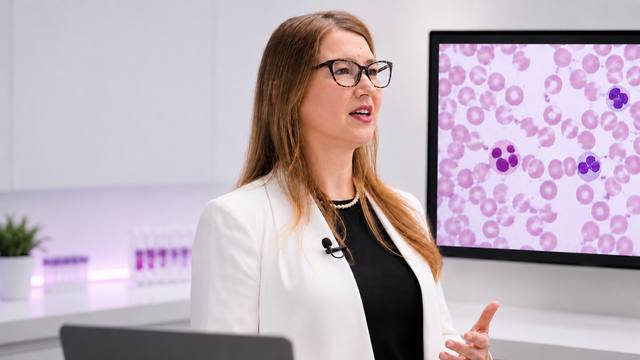
ISLH 2025: Dr. Dobson sharing her experience with Scopio Full-Field Peripheral Blood Smear application
“We are very excited for the forthcoming bone marrow application. That takes the longest time, and having AI support for a 500-cell differential that automatically exports will save time performing and dictating the differential.”
Dr. Robin Dobson, MD, FCAP,
Director of Hematopathology, PathGroup
More stories




- Scopio Labs’ Full-Field Peripheral Blood Smear application is CE marked and FDA-cleared, and it’s commercially available across the U.S., UK and Europe and other territories.
- Scopio’s Full-Field remote capabilities are available through the secure hospital network.
- Scopio’s Full-Field Bone Marrow Aspirate Application is CE-marked and cleared for sale in CE countries as well as in additional regions. Pending FDA clearance in the US.